Citrus Canker Disease has been found in south Texas on October 16th, 2015, the first time since the 1940s. This disease can be devastating to health of the citrus crops, but also has significant implications on the trade and shipment of citrus out of Texas. This is bad news considering citrus producers, state and federal officials have already been working to eradication another exotic disease called Citrus Greening over the past few years.
Florida fought to eradicate citrus canker for almost 100 years before giving up in 2006 after the historic hurricane seasons of 2004 (by the way I lived through it). Texas had eradicated the disease nearly 70 years ago, but now faces another battle of keeping this disease quarantined.
Let's
hope that Texas can learn valuable lessons from Florida, about what
works and what doesn't work.
Florida spent ~$1 billion and removed 16.5 million citrus trees over ten years
trying to eradicate the disease, but later gave up on their eradication
efforts. Quarantine and eradication is the best first step, but spending
time and money on research to develop disease resistance and other
control strategies is also a wise choice. Extension education programs
are important to raise awareness and understanding of Citrus Canker and
other exotic diseases.
For addition information visit the following links:
Roses have been losing the battle with Rose Rosette Disease (RRD) all over Collin County. As a plant pathologist I had seen and worked with this disease in the past, but never have I seen this level of disease pressure, infection rate, and wide spread infection. There are lot of theories on how and why this has happened, but likely they will just remain theories. At our recent Rose Rosette Disease Seminar held at Collin College, we heard from a rose breeder, plant diagnostician, and virologist. They presented research information about this disease and strategies for managing the problem. There were several new discoveries presented that shed some light on the disease and how it is spread.
In late 2014 the Rose Rosette Eradication Alliance (RREA) was formed in an effort to educate the landscape industry, property managers, government officials, homeowners, and the general public. During 2015, the RREA has organized numerous conferences, seminars, and presentations to help increase the availability of information about this disease and how to manage it. The RREA has helped to develop publications, videos, and recommendations for RRD, and assisted with getting out message out.
There is no cure for this viral disease of roses. The management strategy relies heavily on removing roses exhibiting symptoms of the disease so the spread of disease is limited. The virus that causes the disease is spread by a microscopic mite. In North Texas there are countless landscape beds densely planted with roses, which has made it easy for the disease to spread. Landscapes should be designed with a diverse species of plants to prevent the spread of RRD, as well as other disease and insect problems.
New information presented at the recent seminar was the incubation period for this disease is much longer than we previously thought. The incubation period is the time between when the plant is infected and symptoms develop. Current data suggest this can be from 2 weeks to 18 months. A longer incubation period makes managing the disease more difficult, because roses could be a source of infection for a long time before the symptoms develop. Meaning that a healthy rose can be infected, but we just don't know it yet. Therefore removing symptomatic roses, while still very important, won't have as quick of an impact on controlling the spread of the disease as we once hoped. Gardeners should remain vigilant with the community wide effort to remove RRD symptomatic roses.
Questions about trees are by far the most common questions we get at the Extension Office. Trees that are showing symptoms of problems can also be the most difficult to diagnosis. The health of trees is directly related to stress. So what causes stress in trees? In my experience, water issues are the most common stresses. Drought stress has plagued many of our trees in North Texas. Trees are among the toughest plants on Earth but they don't always give us clues they are struggling until it is too late. Other environmental conditions can cause stress on trees and reduce their ability to defend themselves against diseases and insect damage. There are numerous diseases and insects that cause problems with trees. However, two pests tend to attack tree more often during stressful conditions. Hypoxylon Canker is a fungal disease that will kill a tree that is stressed. Wood-boring insects are the most common insect we see killing trees in Collin County. The most important thing you can do to protect the health of your tree is to prevent trees from becoming stressed. Learn more at the Texas A&M Forest Service - Forest Health website.
Watering a Tree
During times of drought, I recommend watering a tree at least once per month by irrigating the top 6 inches of soil within the drip line of the tree (area under the canopy). Most homeowners believe a tree gets enough water from a lawn sprinkler system, but these type of irrigation systems are designed to irrigate turfgrass, not trees. Trees require a irrigation method that allows the water to slowly penetrate deep within the soil profile. The majority of the tree roots are within the top 6 or 12 inches of the soil, so when we irrigate we need to water that profile. Hand watering trees is practical, but if you use a irrigation system then select drip tubing, bubblers, and other device specifically designed for trees. The Texas Forest Service has great video on how to water your tree.
Tree Selection and Planting
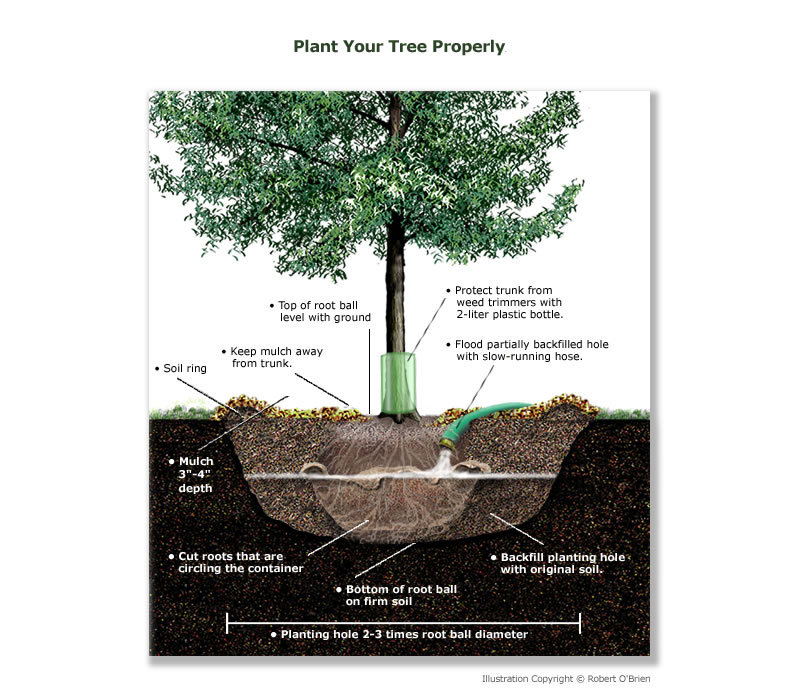
Trees are an important part of our landscapes and the natural environment. Fall is a great time of the year to plant a tree. A tree planted in the fall has a better chance of getting established, than any other time of the year. If you are going to plant a new tree or you are replacing a dead tree, there are many important things to consider. The Collin County Master Gardeners provide resources on selecting the proper tree. The Texas A&M Forest Service has educational videos and Tree Planting website that help make your next tree planting a success.
Removing a Tree
Trees provide countless benefits to humans and the environment. The loss of a tree within your landscape can be difficult. It is important to understand the risk that dead, damaged, or weak trees can have to your neighborhood and surrounding property. The Texas A&M Forest Service publication provide information on Liability of Hazardous Trees. During the process of removing a tree, one of the most importance considerations is selecting a Tree Care Professional to remove the tree. This publication provides advice on how to select a professional. I recommend using a Certified Arborist that has the proper insurance, professional references, and recommendations from trusted sources. You can find a Certified Arborist at the International Society of Arboriculture.
Written by Greg Church, Ph.D. - Horticulture Agent, Texas A&M AgriLife Extension

 Let's
hope that Texas can learn valuable lessons from Florida, about what
works and what doesn't work.
Florida spent ~$1 billion and removed 16.5 million citrus trees over ten years
trying to eradicate the disease, but later gave up on their eradication
efforts. Quarantine and eradication is the best first step, but spending
time and money on research to develop disease resistance and other
control strategies is also a wise choice. Extension education programs
are important to raise awareness and understanding of Citrus Canker and
other exotic diseases.
Let's
hope that Texas can learn valuable lessons from Florida, about what
works and what doesn't work.
Florida spent ~$1 billion and removed 16.5 million citrus trees over ten years
trying to eradicate the disease, but later gave up on their eradication
efforts. Quarantine and eradication is the best first step, but spending
time and money on research to develop disease resistance and other
control strategies is also a wise choice. Extension education programs
are important to raise awareness and understanding of Citrus Canker and
other exotic diseases.


.jpg)